

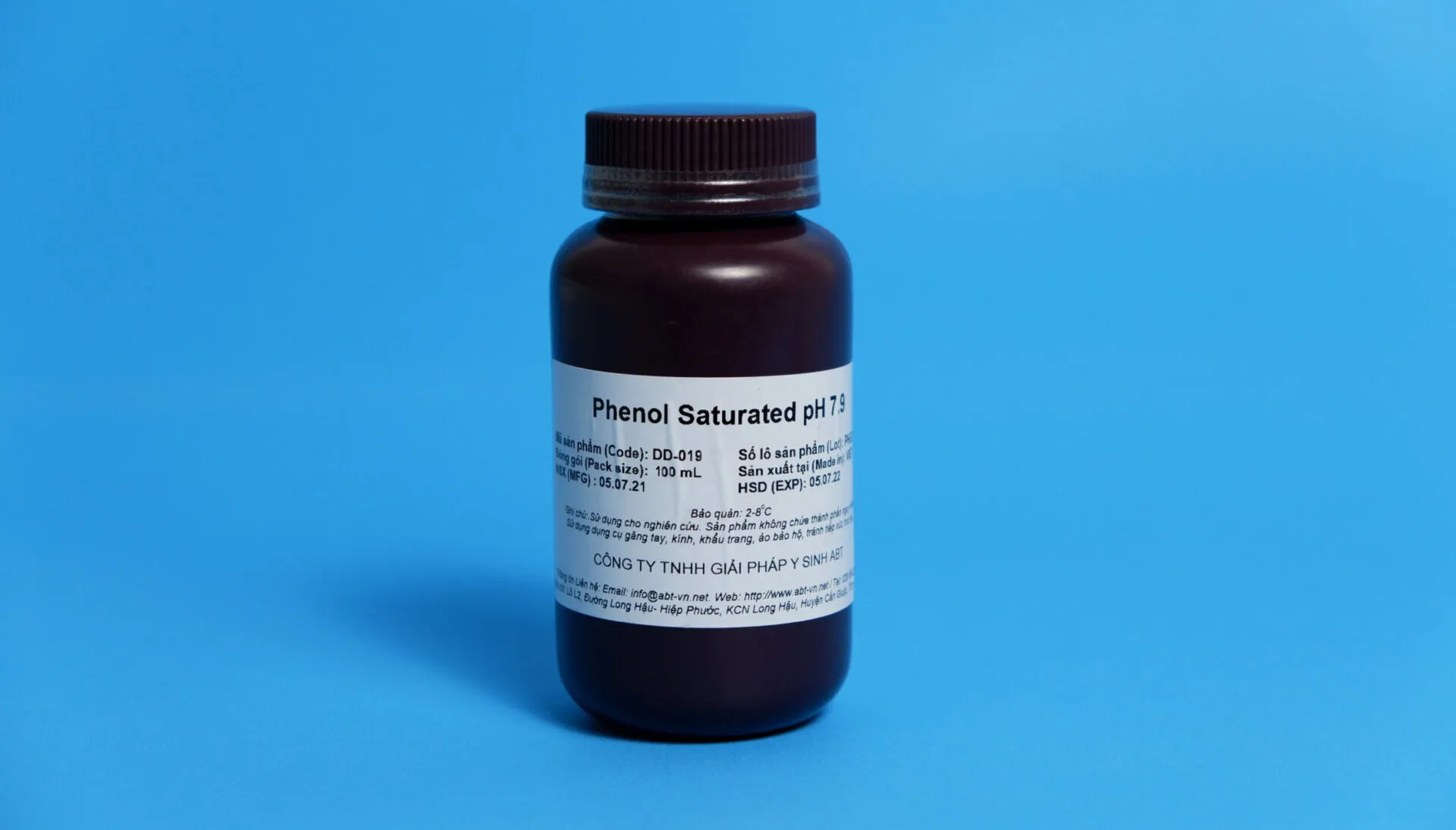

Specifications
Phenol saturated pH 7.9 forms an organic phase capable of separating DNA from proteins. The pH of phenol plays a critical role in determining the phase distribution of DNA during extraction. At pH 7.9, DNA and RNA is completely removed from the aqueous phase and localized at the interface between the aqueous and protein phases.
Due to its high volatility and toxicity, direct contact should be minimized, and appropriate protective equipment is strongly recommended.
Additionally, upon standing, the solution separates into two phases: an upper aqueous phase and a lower phenol phase. Because phenol is highly susceptible to oxidation—especially at higher pH—the aqueous layer is retained in appropriate volume to prevent phenol from direct exposure to air. It is advised not to discard the aqueous layer, as this may compromise extraction efficiency and reduce product shelf life
Phenol saturated pH 7.9 – 250mL Bottle
Manual instruction
Phenol saturated pH 7.9 is commonly mixed with chloroform and isoamyl alcohol in a ratio of Phenol:Chloroform:Isoamylalcohol 25:24:1 for DNA extraction. Below is a reference protocol for DNA isolation:
- Step 1: Add equal volumes of homogenized sample and Phenol:Chloroform:Isoamyl alcohol (25:24:1) into a microcentrifuge tube and vortex thoroughly.
- Step 2: Centrifuge at 13,000 rpm at 2–8 °C for 5 minutes.
- Step 3: Carefully collect the upper aqueous phase, primarily located at the interface with the protein layer. Avoid aspirating the phenol layer or any precipitates.
- Step 4: Add an equal volume of ice-cold absolute isopropanol (2–8 °C), then incubate at −20 °C for 10 minutes.
- Step 5: Centrifuge at 13,000 rpm for 10 minutes.
- Step 6: Discard the supernatant, wash the pellet with 500 μl of 70% ethanol, and allow the DNA to dry completely.
- Step 7: Resuspend the DNA in 50 μl of nuclease-free water.
Read more:


Reviews
There are no reviews yet.