
PCR is a technique that has been mentioned a lot recently in medical diagnostic testing, especially in diagnostic testing for covid-19. PCR testing method is used in the laboratory for the purpose of cloning millions of copies of a target DNA fragment. So what is the main working principle of PCR? And what is the main application of PCR test in medical diagnosis?
What is PCR
PCR (Polymerase Chain Reaction) is a fast and efficient technique used to amplify a small target DNA fragment that produces millions of copies of DNA. In other words, PCR makes it possible to make millions of copies of a particular DNA sequence from a small initial sample or even a single copy.
PCR is considered an important process for a wide range of genetic technologies in medical and biological research. Especially in molecular biology tests, PCR is an indispensable process to help people study deeply into the analysis of DNA/RNA genetic material.
PCR principle
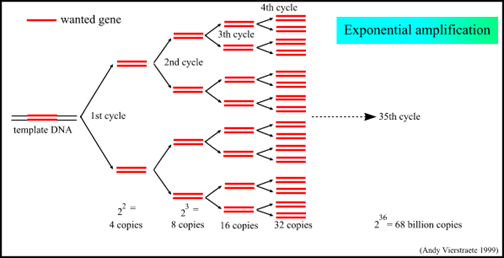
Phản ứng khuếch đại được thực hiện dựa trên nguyên tắc khuếch đại một đoạn trình tự DNA đặc hiệu in vitro do sự xúc tác của enzyme DNA polymerase. Sự khuếch đại này được thực hiện nhờ các chu trình luân nhiệt (có thể 20-40 chu kỳ) gồm 3 bước:
+ Denaturation 95⁰0C: thermal separation of double-stranded DNA into single-stranded DNA.
+ Annealing 40⁰C0- 70⁰C:0allows primers to be paired with the DNA template.
+ Elongation 72⁰C:0new strand is synthesized by the principle of complementarity by DNA polymerase
Các thành phần cần thiết để thực hiện phản ứng khuếch đại

When setting up a PCR reaction, regardless of the DNA sample, the following components are required:
- DNA template
– Mồi (Primer): Là trình tự oligonucleotide có khả năng bắt cặp chuyên biệt với đầu 5’ hay đầu 3’ của đoạn DNA cần nhân bản sao. Mồi được dùng theo từng cặp mồi gồm mồi xuôi và mồi ngược tính theo chiều phiên mã. Mồi xuôi có trình tự nucleotide cùng chiều với sợi mang mã, mồi ngược có trình tự nucleotide bổ sung với sợi mang mã của đoạn DNA cần nhân bản sao.
- dNTP (deoxy nucleotide triphosphate): dNTP is a mixture of 4 components needed for DNA synthesis: dATP, dGTP, dCTP, dTTP.
- DNA polymerase: an enzyme that prolongs the new strand that is complementary to the template strand from the primers with heat-resistant characteristics and does not lose its activity at high temperatures of the denaturation step.
– Dung dịch đệm ( buffer): thành phần Tris-HCl pH 8,3 ; KCl, MgCl2 và Gelatin. Dung dịch đệm có vai trò trong việc tạo sự kết hợp chặt chẽ giữa các dNTP, kích hoạt vị trí hoạt động của DNA polymerase. Dung dịch đệm có ảnh hưởng mạnh mẽ đến tính đặc hiệu và hiệu suất của phản ứng PCR .
A complete PCR reaction can be performed in a few hours, or even less than an hour with certain high-speed machines.
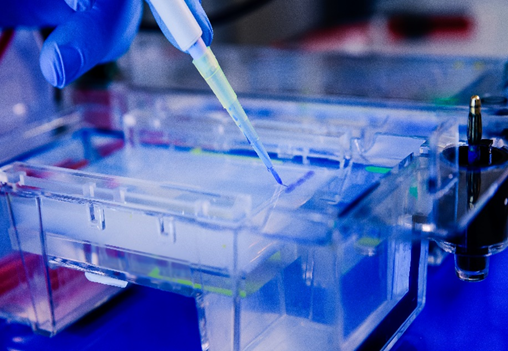
Sau khi phản ứng khuếch đại được hoàn thành trong máy luân nhiệt, một phương pháp gọi là điện di trên gel agarose có thể được sử dụng để kiểm tra số lượng và kích thước của các đoạn DNA được tạo ra.

Application of PCR in medical field
Kỹ thuật xét nghiệm PCR là một công cụ chẩn đoán tuyệt vờicho phép con người nhân lên cả triệu đoạn DNA (RNA) trong thời gian rất ngắn với độ nhạy và độ đặc hiệu cao. Ứng dụng trong chẩn đoán y học bao gồm:
+ Diagnosis of human infectious diseases: Based on detection of infectious bacteria or viruses such as HIV, tuberculosis (TB), Hepatitis B (HBV), Hepatitis C (HCV) Cervical cancer (HPV)...
+ Chẩn đoán các bệnh di truyền, Sửa đổi các đoạn DNA.
+ Forensic analysis: Identification of genetic fingerprints, DNA testing, blood relations, criminal investigation..
+ DNA cloning: Allows researchers to make identical copies of a piece of DNA, studying gene expression
In addition to the medical field, the PCR method is also applied in the production of pathogen diagnostic kits in a variety of other fields, including: Human disease identification, veterinary medicine, aquaculture, food microbiology, etc. identification,..
Hiện nay, công ty ABT là 1 doanh nghiệp hàng đầu áp dụng phương pháp PCR, Real-time PCR thành công trong việc sản xuất các bộ kit chẩn đoán mầm bệnh. Để biết thêm thông tin chi tiết về kỹ thuật xét nghiệm này, cũng như khám phá các bộ kit chẩn đoán của ABT trong Y học: