
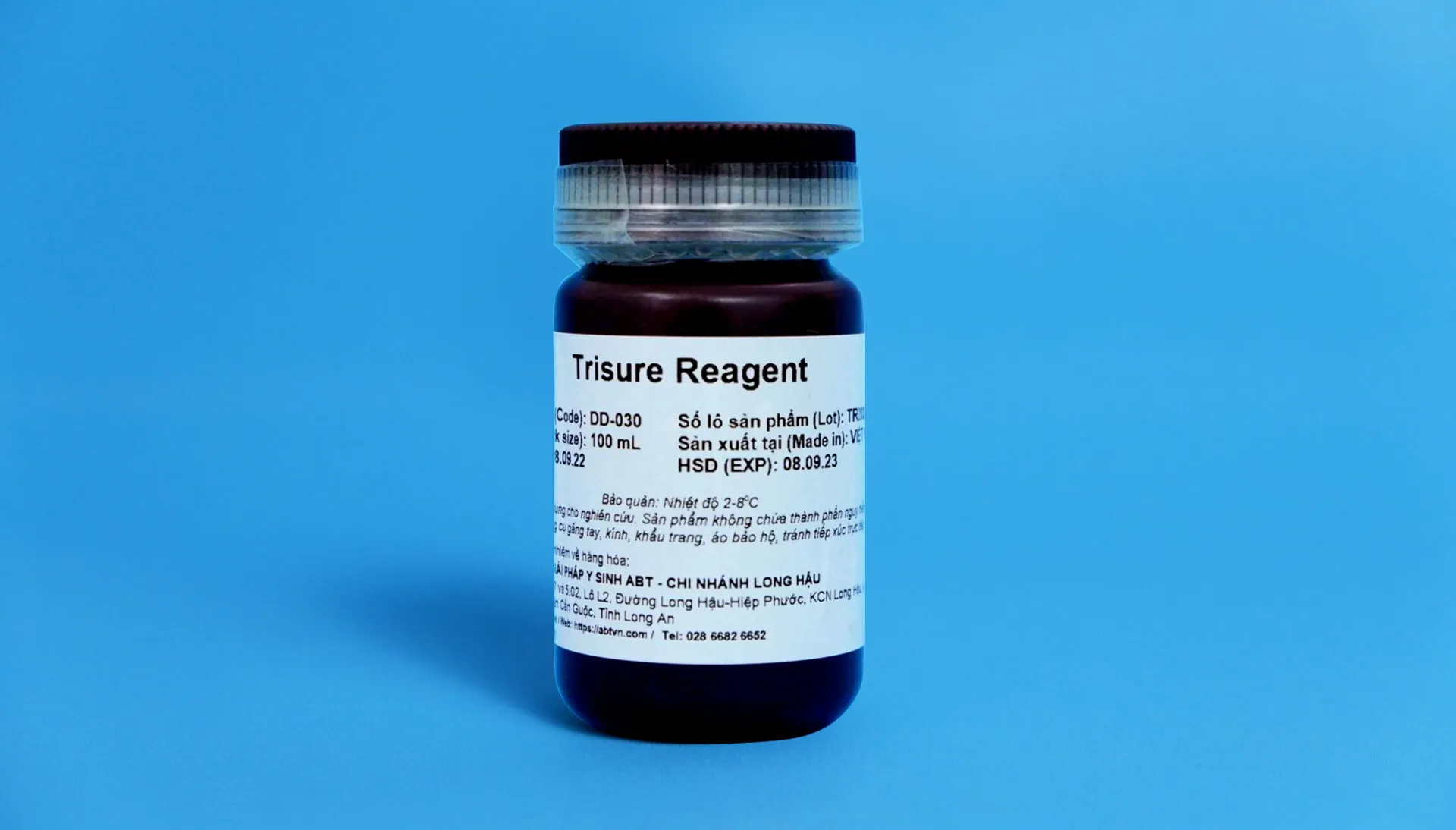
Introduction to TRISURE REAGENT
Trisure reagent is a ready-to-use, fully formulated solution designed for the simultaneous isolation of DNA, RNA, and protein from biological samples, including human, animal, plant, yeast, bacterial, and viral tissues.
Upon application, Trisure reagenthomogenizes and lyses the sample, resulting in phase separation into three distinct layers: a clear aqueous upper phase containing RNA, an interphase containing DNA, and a red organic lower phase containing protein.
RNA is extracted from the aqueous phase via precipitation with 2-propanol. The Trisure reagent ’s potent RNase-inhibitory properties ensure the preservation of RNA integrity during lysis, facilitating the isolation of high-quality nucleic acids.
DNA is recovered from the interphase by ethanol precipitation, while proteins are obtained through sequential precipitation from the phenol-ethanol supernatant using 2-propanol.
Manual instruction
1. Sample preparation
- Tissue samples:
- Homogenize 50–100 mg of tissue in a 1.5 mL microcentrifuge tube with 1 mL of TRISURE Reagent.
- Note: Vortex intermittently during incubation.
- Monolayer cell samples:
- Apply 1 mL of TRISURE Reagent per 10 cm2 of glass culture dish surface.
- Note: Do not use TRISURE Reagent on plastic culture dishes.
- Immune cells samples:
- Isolate cells by centrifugation, aspirate supernatant, add TRISURE Reagent, and mix thoroughly by pipetting.
- Use 1 mL of reagent to lyse 105 – 106 cells from animal, plant, yeast, or bacterial sources.
2. Phase separation
- Step 1: Allow the sample to stand for 5 minutes at room temperature.
- Step 2: Add 0.1 mL of 1-bromo-3-chloropropane or 0.2 mL of chloroform to each 1 mL of TRISURE Reagent.
- Step 3: Seal the tube, shake vigorously for 15 seconds, and incubate for 2–15 minutes at room temperature.
- Step 4: Centrifuge the mixture at 12,000×g for 15 minutes at 2–8°C.
This centrifugation step separates the mixture into three distinct phases: upper aqueous phase (clear, contains RNA), interphase (contains DNA) and lower organic phase (red, contains protein).
3. RNA isolation and extraction
- Step 1: Transfer the aqueous phase to a new tube. Add 0.5 mL of 2-propanol per 1 mL of TRISURE Reagent used during sample preparation. Mix thoroughly.
- Step 2: Incubate for 5–10 minutes at room temperature, then centrifuge at 12,000×g for 10 minutes at 2–8°C.
- Step 3: Discard the supernatant. Wash the RNA pellet by adding 1 mL of 75% ethanol per 1 mL of TRISURE Reagent used in sample preparation.
- Step 4: Vortex briefly to resuspend, then centrifuge at 7,500×g for 5 minutes at 2–8°C.
- Step 5: Rapidly dry the RNA pellet for 5–10 minutes at room temperature or under vacuum.
- Step 6: Add an appropriate volume of formamide, water, or 0.5% SDS solution to the RNA pellet. To facilitate dissolution, mix repeatedly by pipetting and incubate at 55–60°C for 10–15 minutes.
4. DNA isolation and extraction
- Step 1: Carefully remove any residual aqueous phase above the interphase. Add 0.3 mL of 100% ethanol per 1 mL of TRISURE Reagent used during sample preparation. Mix gently and incubate for 2–3 minutes at room temperature. Centrifuge at 2,000×g for 5 minutes at 2–8°C to precipitate DNA from the interphase and organic phase.
- Step 2: Wash the DNA pellet twice using a solution of 0.1 M trisodium citrate in 10% ethanol. Use 1 mL of wash solution per 1 mL of TRISURE Reagent used. Each wash should last at least 30 minutes, with occasional gentle pipetting. Avoid disrupting the DNA pellet.
- Step 3: Centrifuge at 2,000×g for 5 minutes at 2–8°C. Store the DNA pellet in 1.5–2 mL of 75% ethanol per 1 mL of TRISURE Reagent used. Incubate for 10–20 minutes at room temperature.
- Step 4: Dry the DNA pellet under vacuum for 5–10 minutes. Dissolve the pellet in 8 mM NaOH by pipetting.
- Step 5: Centrifuge at 12,000×g for 10 minutes to remove insoluble material. Transfer the supernatant to a new tube.
a. DNA Amplification by PCR
After dissolving in 8 mM NaOH, adjust the pH to 8.4 using HEPES free acid (add 86 μL of 0.1 M HEPES per mL of DNA solution). Add 0.1–1 μg of DNA to the PCR mixture and proceed with standard amplification protocols
b. DNA Digestion with Restriction Enzymes
Adjust the DNA solution to the optimal pH for enzyme activity using HEPES buffer, or dialyze against 1 mM EDTA, pH 7–8. Incubate with restriction enzymes for 3–24 hours under optimal conditions.
5. Protein isolation
- Step 1: Precipitate proteins from the phenol–ethanol supernatant (obtained during DNA isolation) by adding 1.5 mL of 2-propanol per 1 mL of TRISURE Reagent used during sample preparation. Allow the mixture to stand for at least 10 minutes at room temperature. Centrifuge at 12,000×g for 10 minutes at 2–8°C.
- Step 2: Discard the supernatant. Wash the protein pellet three times, each for 20 minutes, using a solution of 0.3 M guanidine hydrochloride in 95% ethanol at room temperature. Use 2 mL of wash solution per 1 mL of TRISURE Reagent used during sample preparation.
- Step 3: Centrifuge at 7,500×g for 5 minutes at 2–8°C. After three washes, add 2 mL of 100% ethanol, vortex briefly, and incubate for 20 minutes at room temperature. Centrifuge again at 7,500×g for 5 minutes at 2–8°C.
- Step 4: Dry the protein pellet under vacuum for 5–10 minutes. Resuspend the pellet in 1% SDS solution by pipetting. Centrifuge at 10,000×g for 10 minutes at 2–8°C to remove insoluble contaminants. Transfer the supernatant to a new tube. The protein solution should be used immediately for Western blotting or stored at –20°C for future use.
Read more:


Reviews
There are no reviews yet.